
The standard for measuring how a workforce actually adopts AI.
Companies everywhere are investing in AI, and almost none of them can see where their people stand with it. The Institute publishes an open standard for measuring exactly that, an annual report on the state of it, and industry benchmarks built from anonymized data, so that leaders are working from evidence instead of anecdotes.
Why we exist
Everyone is using AI. Very few are getting anything out of it.
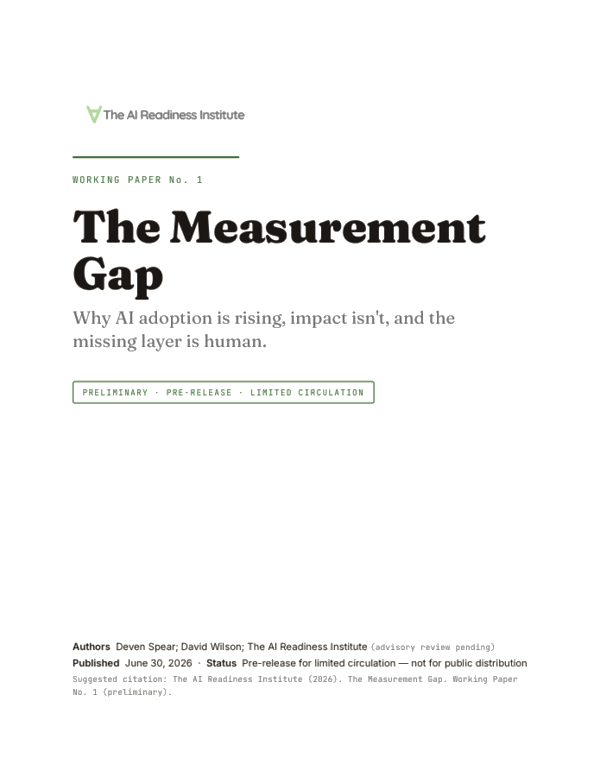
Nearly every company has adopted AI in some form, and most of them can’t point to any measurable return. The problem is rarely the technology. It’s that nobody has measured the people: how they feel about AI, how capable they are with it, and whether anyone has helped them get better. The readiness tools on the market today grade countries or grade companies. None of them look at the individual worker, which is where adoption actually succeeds or fails. That’s the gap we exist to close.
0%
of organizations see any profit impact from AI — even though 88% now use it regularly.
McKinsey, State of AI in 2025
0%
of leaders report an AI skills gap — despite already spending on training.
DataCamp / YouGov, 2026
0%
of employers plan to upskill their workforce for AI.
World Economic Forum, Future of Jobs 2025
0%
of employees would use AI even when it isn’t authorized — shadow AI is real.
BCG, AI at Work 2025
0%
of desk workers strongly agree they’re adequately trained to use AI.
Slack Workforce Lab, 2024
The standard
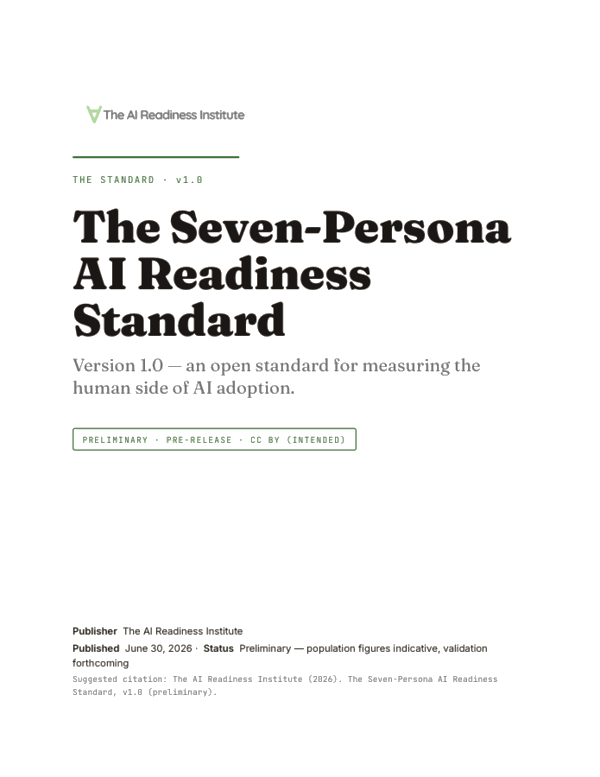
The seven-persona AI readiness standard
The serious research on AI adoption keeps landing on the same two questions: how people feel about AI, and how well they actually use it. A third factor, whether the organization enables them, moves people between categories. The Institute consolidated that research into seven personas, built on the diffusion-of-innovations model that has described how technology spreads for sixty years. The standard is open and citable, and anyone may adopt it.

Fluent, committed, and openly selling AI to everyone around them.

A heavy, skilled user who keeps it quiet or works with tools nobody approved.

Enthusiastic and willing, but barely using it yet. Cheering from the sidelines.
Pragmatic. Adopts when given tools, permission, and training.

Aware of AI and watching it, but indifferent, and not using it.
Capable, but doesn’t trust AI’s reliability and worries it will erode real skills.

Actively opposed. Sees AI as a threat, and resents it when others use it.
Built on the best research in the field, and more complete than any one piece of it.
BCG, Slack’s Workforce Lab, and the World Economic Forum have each published persona models, and we credit all of them in our work. Each covers part of the picture. Our standard adds the two types the others miss: the Eager Novice, who is willing but unskilled and is usually a company’s cheapest win, and the Resistor, who actively opposes AI and is the risk nobody else is tracking. It also scores all seven types on attitude, skill, and enablement together, not attitude alone.
Cite this standard: The AI Readiness Institute, Seven-Persona AI Readiness Standard v1.0 (2026) — published under CC BY; cite and adopt freely. Sources: McKinsey (2025); WEF Future of Jobs (2025); DataCamp/YouGov (2026); BCG AI at Work (2025); Slack Workforce Lab (2024); Rogers, Diffusion of Innovations.
Methodology
How we built it, and how we plan to prove it.
The standard pulls together the strongest public research on workplace AI adoption from 2024 through 2026, anchored to two established instruments: the Technology Readiness Index and Rogers’ diffusion-of-innovations framework. We publish our sources. We label what is synthesis and what is our own benchmark data, and we state the unit of analysis for every figure. We are also pre-registering an independent validation study of the persona instrument, because as far as we can tell, no commercial AI-adoption persona model on the market has ever been independently validated. We intend to be the first.
The flagship report
The State of AI Readiness
Our annual report tracks how ready workforces actually are, across industries and company sizes: the mix of persona types, the five readiness dimensions, and the problems that most often stall adoption. The first edition builds the foundation from public evidence and lays out the methodology. As anonymized assessment data accumulates, the benchmarks get richer. No personally identifiable information is ever included, in any edition.
Inaugural edition — in preparation
The first edition is being assembled now, built from the public evidence, with our own benchmark data layering in as assessments accumulate.
Download
Publications & the standard
Published under CC BY — cite and adopt freely.
About
Close the measurement gap.
Companies are spending heavily on AI capability, and most of them still can’t see where their people actually stand. The Institute exists to close that gap with rigorous, independent, openly published research.
We deliberately study readiness, not just “AI readiness.” Technologies come and go. The discipline of understanding how a workforce adopts a new tool, learns to trust it, and gets enabled to use it well is durable. Our standards are built to outlast any single technology moment.
On independence: Readigence, the assessment platform built on our standard, funds part of our work and contributes anonymized data to it. We say so on every publication. What we publish is what the evidence shows, whether or not that’s convenient for Readigence or anyone else, and the data we use never carries personally identifiable information.
Governance & funding
The Institute is guided by a board with an independent majority, and a Research Advisory Council reviews methodology before anything is published. Part of our funding comes from Readigence, which also contributes anonymized assessment data. We name our funders, and no funder approves our conclusions. That separation is the whole point: we publish what the evidence shows, including findings that are inconvenient for a funder or partner. (Seats and the conflict-of-interest policy published as filled.)
The data covenant
Our benchmarks come from anonymized, pooled assessment data. We never publish a number for any group small enough that someone could work out who’s in it, and no personal information ever enters a benchmark. Anyone who takes a Readigence assessment can answer anonymously, and that anonymity is enforced in the data itself, not just promised in a report.
Who we are
The people behind the standard
Research Advisory Council members are named here as seats are filled.

Deven Spear
Co-founder
Systems architect and technical founder. Builds the platforms and standards behind the Institute’s research, with a focus on AI and how workforces adapt to it.
LinkedIn ↗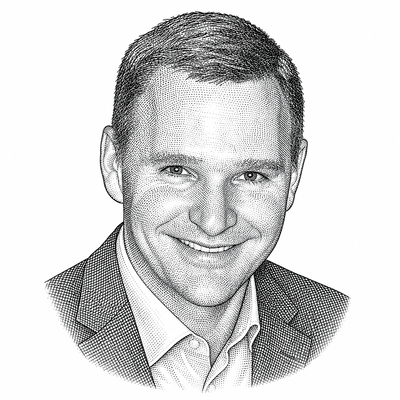
David Wilson
Co-founder
Leads research and measurement. His survey-science and market-research background anchors the standard’s methodology.
LinkedIn ↗The Institute sets the standard. Readigence applies it.
Readigence is the assessment platform that puts this research to work, and it funds part of the Institute’s work and contributes data to it. Every benchmark we publish is built from anonymized, pooled data with no personal information in it. We disclose the relationship on everything we publish, and our findings stay independent of it.